




Survival rates up another 7% in the Stavanger region
 Most cardiac arrests occur out of hospital.
Major findings from the study period
Here is what the researchers found when comparing survival to discharge with good outcome in two time periods (2001-2005 vs. 2006-2008):
- Bystander CPR increased significantly
- Overall rate of survival to discharge increased significantly
- In patients with a shockable first rhythm, rate of survival to discharge increased
 Like any chain, the Chain of Survival
 is only as strong as the weakest link.
Good outcome is linked to the Chain of Survival
The reason for improved outcomes in the Stavanger area is believed to be multi-factorial and linked to improvements in the local Chain of Survival. By ensuring that each and every step of the chain is thoroughly implemented, other regions should be able to increase their survival rates as well.
Next questions in line
But which parts of the chain were in fact improved in the Stavanger area? And how were they improved? And further, are the measures transferable to other regions and to other countries? These questions needs more looking into, so that local implementation of the Chain of Survival can move forward more efficiently in the time to come, hence more lives can be saved.
| The medical knowledge is in place and so is a wide selection of efficient learning methods. Hence the remaining challenge moving forward is local implementation. Managing each and every step of the Chain of Survival will help saving more lives. | 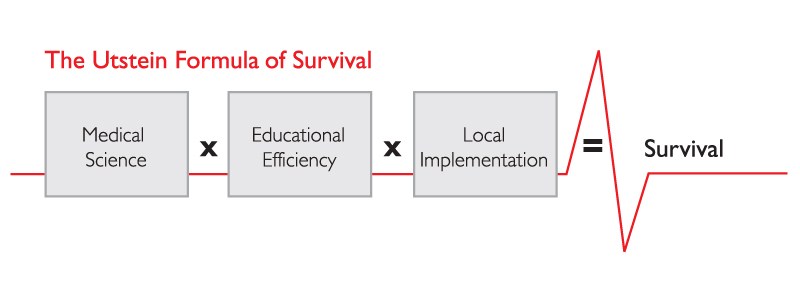 |
Research abstract:
Good outcome in every fourth resuscitation attemp is achievable--an Utstein template report from the Stavanger region.