Why Don’t Passive Methods for Continuous Improvement Work?
And what to do instead.
And what to do instead.
When healthcare quality falters, our first instinct is often to retrain staff, revise a protocol, or issue a new policy. But these passive approaches rarely result in meaningful change. To improve outcomes and reduce risk, healthcare organizations need methods that actively examine, test, and improve the systems themselves. Simulation provides that method.
Dr. Victoria Brazil
Director, Bond Translational Simulation Collaborative; Professor of Emergency Medicine and Director of Simulation, Bond University

A near-miss in the ICU. A hemorrhage case that didn’t go according to plan in Labor & Delivery. Miscommunication during an emergency handoff in the ED. In the wake of these types of events, hospitals often reach for well-worn quality improvement (QI) responses:
Are these the types of solutions you are familiar with? If so, you are not alone. And you have likely been disappointed by the results. That stands to reason. The above are all passive methods—interventions that assume the problem lies in individual knowledge or motivation, rather than in the system itself.
And they often fail.
An analysis of safety reports by the Agency for Healthcare Research and Quality (AHRQ) and related studies consistently indicates that breakdowns in communication and systemic process failures are the root causes of most adverse events—not knowledge deficits. Yet training is often the go-to fix, often assigning “blame or liability” in the process.2
Protocols are valuable, but if they’re never rehearsed in context—under real pressure, with actual teams—they risk failure when it counts. Policies alone don't ensure behavior change.
- Dr. Andrew Petrosoniak, MSc (Med Ed), FRCPC,
Emergency Physician and Trauma Team Leader at St. Michael’s Hospital in Toronto, Canada

Written communication may raise awareness, but it doesn’t embed new workflows or habits. Without practice and feedback, performance gaps persist.
"Designing a great organization, process, or system is only the beginning. It’s up to leadership to create an environment in which employees embrace and adopt new behaviors, relieved of the frictions that too often impede adoption and ultimately thwart change efforts.”4
- Tracy Thurkow and Adélaïde Hubert,
Bain & Company
Disciplinary responses send the message that individuals—not systems—are the problem. They damage morale, create fear, and discourage open reporting, all while the root cause remains untouched.
"Healthcare professionals are [often] punished for being human. This drives fear, suppresses error reporting, and ultimately puts patients at risk. ... The focus must shift from determining who is at fault when errors happen, to determining what went wrong, what we can learn, and how to improve the system overall."5
- Marcus Schabacker,
President and CEO of ECRI
Simulation offers a powerful alternative—an active, system-focused approach to quality improvement that enables hospitals to move from reactive fixes to proactive learning.
- Dr. Andrew Petrosoniak, MSc (Med Ed), FRCPC,
Emergency Physician and Trauma Team Leader at St. Michael’s Hospital in Toronto, Canada
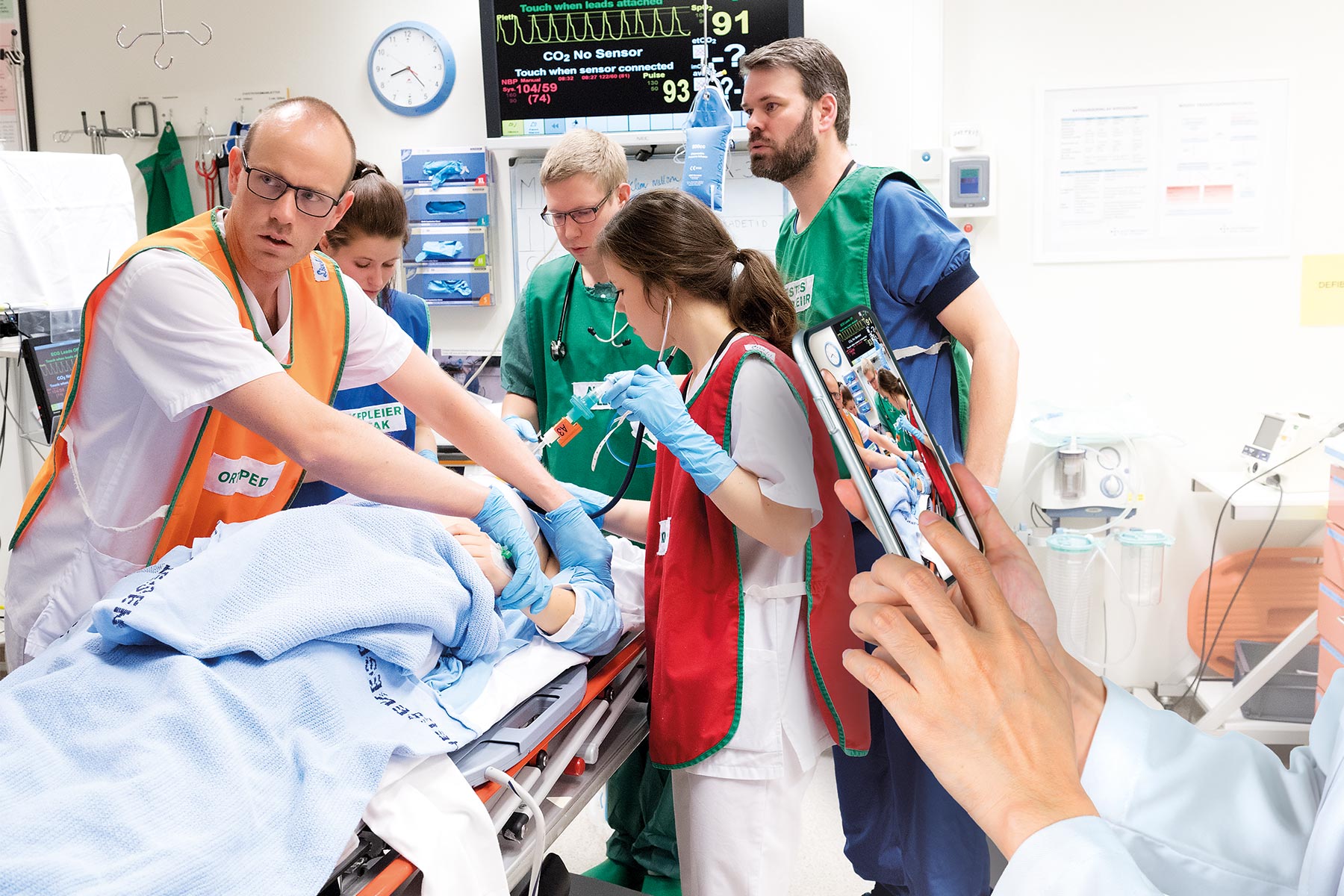
29 pediatric emergency sessions involving 98 participants were conducted in situ to improve acute pediatric care. This was part of a critical incident analysis of an adverse event that happened in the paediatric accident and emergency department. Errors identified included three key drugs continually out of stock, consumables out of stock, staff unfamiliarity with location and use of key equipment.
Result: Systems changes were put in place to include Pharmacy as part of the accountability process, Rx check sheets for the emergency staff, regular inventory protocol, and remedial training. 7
In 12 trauma simulations, the hospital’s teams uncovered over 150 critical latent safety threats. The simulations led to improved trauma bay design, workflow changes, and faster, more coordinated care.
Result: Real-world trauma cases showed more consistent team performance and reduced errors.8
At Bryan Health in Nebraska, rural hospitals conducted postpartum hemorrhage simulations that revealed gaps in emergency protocols and resource locations.
Result: Hemorrhage carts were repositioned, blood delivery protocols revised, and communication workflows clarified. One physician said, “A week after our OB team completed the simulation training program, we put our training to work in a postpartum hemorrhage requiring a massive transfusion protocol. The simulation was invaluable.”9
Here’s how to shift your QI response from reactive and passive to simulation-informed and proactive:
Identify the Right Use Case
Choose a recurring risk point: delayed blood delivery, code team coordination, neonatal handoff, OB hemorrhage, or medication errors.
Run a Realistic Simulation
Use in-situ scenarios with actual equipment, roles, and space.
Observe System Performance
Watch how communication flows. Where do people hesitate? What’s missing?
Debrief and Co-Design
Debrief with frontline staff. Use their insights to refine workflow, layout, or policy.
Test Again
Repeat the simulation with the new process. Measure improvement and confidence.
Embed and Reinforce
Use simulation to build the muscle memory needed for sustained change.
Passive methods like retraining, protocols, or memos rarely fix system issues. Simulation provides an active, collaborative way to identify gaps, test solutions, and embed safer care.
Continuous improvement doesn’t happen by accident—or by memo. Let simulation help you move from passive fixes to active transformation.