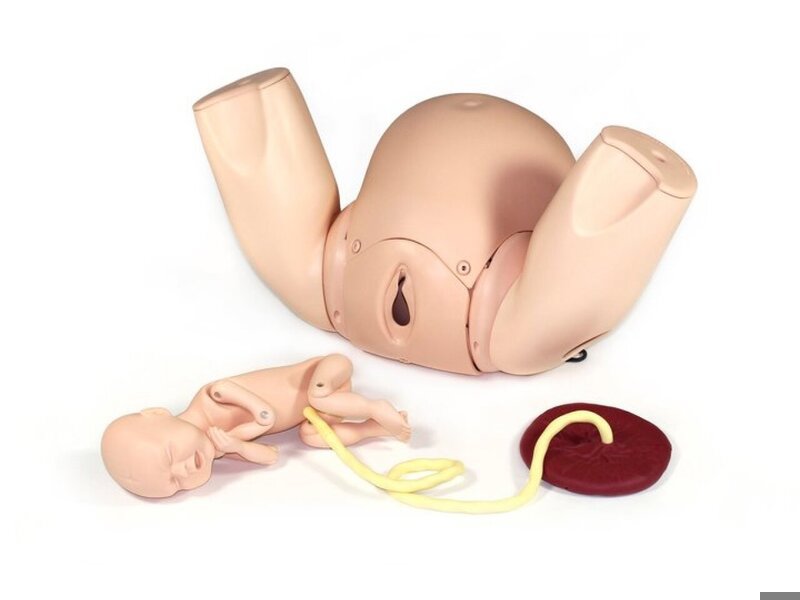
The PROMPT Flex Standard Light is an anatomically correct birthing simulator with a modular design, allowing for multiple training scenarios. It is an ideal training solution for all skills relating to both routine and non-routine deliveries, and can be used for hybrid simulation as well as stand-alone bench top training.
Included with this task trainer, is the Enhanced PROMPT Flex Standard Baby. The baby represents a full-term infant, which works with the PROMPT Flex Birthing Mother (LIM-80120) to simulate normal and difficult birthing scenarios. Improved shoulder and hip joints further enhance the realism in difficult birthing situations such as deeply impacted head and shoulder dystocia.
To further extend use, additional modules for Post-Partum Hemorrhage (LIM-80101), Cesarean-section (LIM-80103) and Cervical Dilation and Effacement (LIM-80102) are available.
This product is available in a dark skin-tone (LIM-80200).
Light Skin tone.
REALISM
Suitable for use with Simulated/Standardized Patient
VERSATILITY
Realistic pelvic floor
Articulating thighs for McRobert’s procedure
Stretchable perineum
Soft, flexible birthing canal
Additional modules available to extend training:
Post Partum Hemorrhage management
C-section
Cervical dilation and effacement
Optional lower legs available for all fours position
CLEANING
Skin washable with soap and water
SAFETY
Latex free
ANATOMY
Birth canal and cervix
Ischial spines and pubic bone
Gynecoid pelvis
Articulating thighs
Fully articulated baby with clavicles, fontanelles, flexible head and detachable umbilical cord and placenta
SKILLS GAINED
Training and practice in the following types of birth:
Normal
Vaginal breech
Shoulder dystocia
Vaginal assisted (forceps and vacuum devices)
Third stage of labor
Cord prolapse
Urinary catheter placement
IM injection
Communication and teamwork skills
EVIDENCE
Improving Neonatal Outcome Through Practical Shoulder Dystocia Training.
Draycott, T. J., J. F. Crofts, et al. (2008). "Improving Neonatal Outcome Through Practical Shoulder Dystocia Training." Obstet Gynecol 112(1): 14-20.
Management of Shoulder Dystocia: Skill Retention 6 and 12 Months After Training. Crofts, J. F., C. Bartlett, et al. (2007). "Management of Shoulder Dystocia: Skill Retention 6 and 12 Months After Training." Obstet Gynecol 110(5): 1069-1074.
Shoulder dystocia training using a new birth training mannequin. Crofts, J. F. A., Georgios; Read, Mike; Sibanda, Thabani; Draycott, Timothy J. (2005). "Shoulder dystocia training using a new birth training mannequin." BJOG: An International Journal of Obstetrics & Gynaecology 112(7): 997-999.