Educación Médica Basada en Competencias
Descubre cómo CBME utiliza la simulación para desarrollar competencias clínicas y preparar a los futuros médicos para la atención en el mundo real.
Más informaciónAn Interview with Dr. Brian Mann

Dr. Brian Mann, EdD, MD, PA-C, from the Philadelphia College of Osteopathic Medicine, USA, discusses how simulation, multimodal assessment, and emerging technologies can move competency-based education beyond knowledge and into real-world performance.
Watch the video or read the transcript below.
“My name is Dr. Brian Mann. I’m the dean of the school of health professions sciences at Philadelphia College of Osteopathic Medicine. I’ve been involved in simulation for the past 11 years at several different institutions.
I find that experiential learning is just one of the best ways to learn. And I think it’s probably the future of where we’re going, with how we’re starting to work in competency-based education into our overall curriculums. It’s not the whole answer. It never will be the whole answer. But it’s definitely a great starting point.
I really enjoy everything that I do every day. It’s one of those things where you just come and love what you do.
My background: I’m a surgical physician assistant. Prior to that, I was a paramedic and a fireman in the suburbs of Cleveland, Ohio. I’ve done everything from emergency medicine, to transplant medicine, to interventional airway and bronchoscopy, and pulmonary critical care.”
“For many people who are involved with academics of learning how to develop curriculum and in designing curricula, we’ve had some premises that we’ve always lived by. And there are best practices that have already been created through the use of simulation in those best practices. We’re just asking people to consider some different things.
When you look at it from a competency-based education model, one of the premises of competency-based education is that it’s not time-bound and that learners progress at their own speed, which does challenge some of the status quo of where we are academically. But I think that we’re really starting to learn more each and every year as we start to embark on this journey together.
Specifically with simulation and where it’s actually set. So while I can say that today the answer would be this, I’m not sure that that same answer would be there in the next year or two, because I think with technology advances that are coming, we’re going to see that competency-based education does have a footprint, and is something that is achievable. But we need to start doing it a little more.”
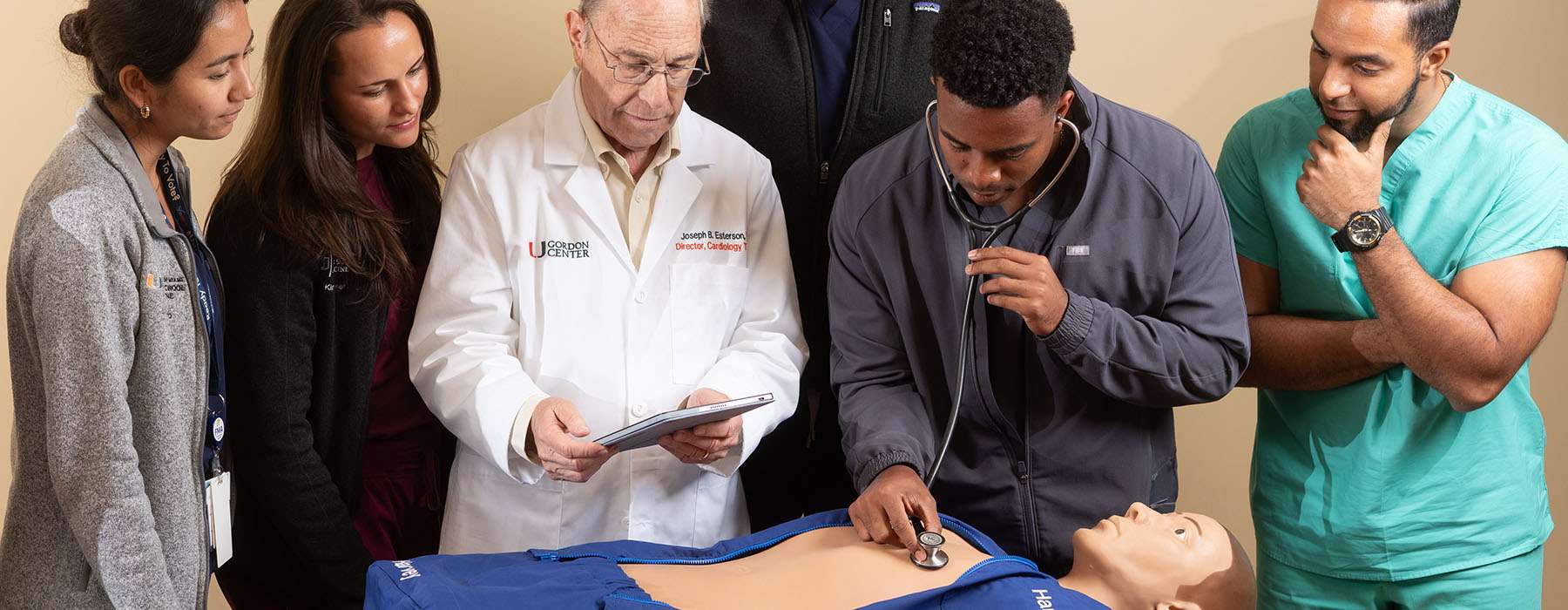
“Because the key component of competency-based education is multimodal assessment. So that means many different types of assessment, or different types of experiences that are assessed in many different ways over time.”

“I think one of the absolute, most technologically advanced components of what we’re seeing today would be anything that revolves around data analytics, specifically with either generative AI or, I would even dare to say, quantum computing. I think that’s going to help us to see things that we don’t see right now in how individuals are educated, how they respond to feedback, how they’re given feedback.
I think it’s endless, what can actually happen. I really think it is these components of AI that are going to help us with the data analytics that we need to help our students progress forward—not just while they’re students, but while they’re working through their professional career also.
Because remember, a competency-based education in and of itself is not a paradigm that stops after education or after someone graduates. It truly is lifelong—all the way from undergraduate medical education, through graduate medical education, to training for fellowships, all the way through professional lifelong work.
Overall, you’ll see that we would hope that data could be shared—if we want to not only think about this just from a one school, one state, one country, or even one region of the world [perspective]—we can think about this globally. How is that data used to influence patient safety and patient care over time?
I think that really is where it lies. Some of the challenges with that, though, are who’s going to collect it all? And then again, what are some of the costs that are associated with that? We’re seeing that a little bit now. And then, what are the resources that can go into that? If we can develop those resources that people can have, their data can be securely placed into these areas and can be used for the better good, then I think we might have something.”
Note: The views Dr. Mann has expressed are his own and should be understood as personal perspectives, not those of any institutions or organizations he is affiliated with.