Scaffolding Learning in CBE with SimZones and vrClinicals
In this interview, explore how the University of Kansas School of Nursing is scaffolding multi-modal simulation activities to build competence.
Learn More

Associate Professor, Director of Simulation
University of Minnesota
If you’re in nursing education, you know that clinical judgment remains one of the most critical competencies in nursing education. And, you also know that it’s one of the hardest to teach and evaluate consistently.
At the 2026 Simulation User Network (SUN) Conference, Cynthia Bradley, PhD, RN, CNE, CHSE, ANEF, Associate Professor and Director of Simulation at the University of Minnesota School of Nursing, shared how immersive virtual reality in nursing education (IVR) and artificial intelligence (AI) can help nurse educators better understand and support the development of clinical judgment.
In this article, we provide a summary of Dr. Bradley’s SUN session, “Clinical Judgment, VR, and AI: A Winning Trifecta.”
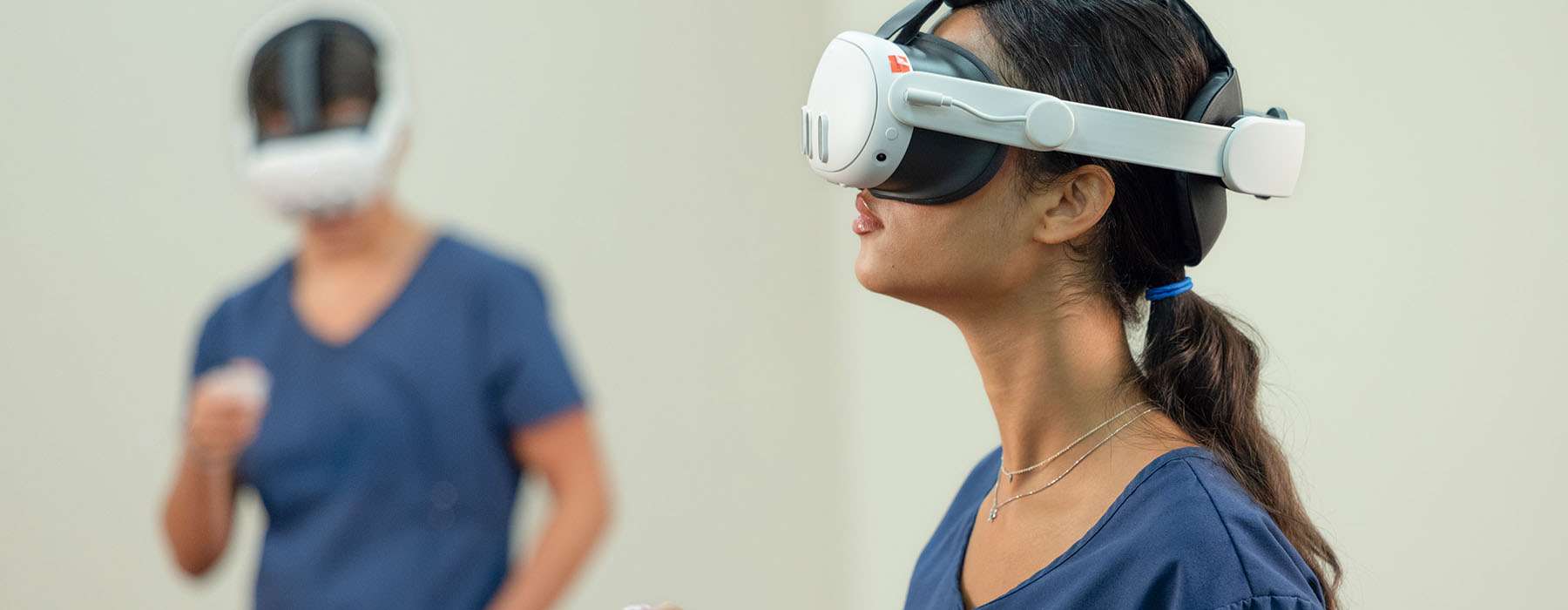
Dr. Bradley grounded her session in a challenge nurse educators know well. Clinical judgment is essential for safe practice and directly tied to patient outcomes, yet it’s deeply complex. Even when students are taught steps, protocols, and processes, “they still have to pick up that reasoning and that thinking piece,” Dr. Bradley pointed out.
“Clinical judgment is one of the most difficult things that we’re trying to teach,” she said. “It’s very difficult to measure.”
Traditional clinical experiences vary widely. Even students placed on the same unit encounter different patients and learning opportunities. Evaluation depends heavily on faculty observation, which can be subjective and inconsistent.
Simulation helps address variability in clinical experiences, but Dr. Bradley emphasized that immersive virtual reality (IVR) in nursing education takes standardization further. In IVR, every learner encounters the same environment, cues, and decision points.
IVR also shifts assessment away from solely faculty interpretation. “IVR removes all of that subjectivity—because it’s a computer program at the end of the day,” she said.
Before IVR platforms like vrClinicals for Nursing, educators had limited insight into what students were actually doing during simulated patient care. “If we can’t really understand what they’re doing, we have no idea how to help them improve,” she said.
IVR environments generate a tremendous amount of learner data. Dr. Bradley referred to this data as IVR telemetry. This includes actions taken, timing, sequence, omissions, and responses to changing patient conditions.
“We can see their actions, we see the timing of what they have done, the sequence of events,” she said. “We see what they don’t do. Sometimes that’s very important to know also.”
Within platforms like vrClinicals for Nursing, educators can examine how students assess patients, navigate protocols and orders, and prepare to escalate care.
“Are they making a call to the provider?” she asked. “Do they have the data that they need to make that call, or do they have to go back and reassess?”
She pointed specifically to the value of multi-patient environments. “We can look at the prioritization patterns,” she explained. “How do they handle interruptions?”
By capturing these patterns through IVR telemetry, platforms like vrClinicals provide educators with objective evidence of how learners recognize cues, prioritize care, respond to interruptions, and manage competing demands.
“We have one student who said, ‘I was able to answer some questions on NCLEX because of George [from the VR scenario],’” she shared. Examples like this illustrate how platforms such as vrClinicals support deeper understanding and application.
To turn telemetry data into insights, Dr. Bradley stressed the importance of a shared framework. She uses the Clinical Judgment Measurement Model to interpret learner behavior across recognizing cues, analyzing information, prioritizing hypotheses, taking action, and evaluating outcomes.
“Telemetry doesn’t interpret itself,” Dr. Bradley explained. “We need a shared lens.”
For each IVR scenario, educators must determine which behaviors demonstrate judgment in that context. Did the learner reassess after an intervention? Did they escalate appropriately? Did they reprioritize care when conditions changed?
Using this approach, Dr. Bradley uncovered a pattern among struggling learners. “They just keep reassessing and reassessing,” she said. “They never take action.”
Because vrClinicals records timing and sequence, those patterns become visible and discussable in debriefing, with scenario actions and interruptions designed around the Clinical Judgment Measurement Model.

AI plays a supporting role by helping educators organize and interpret large volumes of telemetry data generated by immersive VR platforms like vrClinicals.
But AI doesn’t replace nurse educators. “AI will never replace nurse thinking,” Dr. Bradley pointed out. She emphasized that educator judgment must remain central.
When used “with guardrails,” AI helps educators move faster from evidence to action. “I want to know today: how did my students do?” Dr. Bradley said. “Not next semester, not next year, but this cohort today.”
AI-supported analysis can surface cohort-level gaps such as delays in escalation, missed safety checks, or difficulty evaluating outcomes. Those insights allow educators to adjust debriefing, remediation, and even curriculum in near real time.
“Does [the analysis] change how I debrief the next time I do this scenario? Does it maybe inform how I need to tweak their prep materials, or something they need to get before they do this VR the next time?” she explained.
“Maybe it’s just building into our curriculum, where we need to repeat something,” she adds. “Competency-based education is not a one-and-done. We want them to demonstrate competence again.”
Dr. Bradley urged educators to approach immersive VR thoughtfully.
“Here’s my best advice: start low and slow,” she advised. She recommended starting with one course and one scenario and investing in thorough orientation to both hardware and software.
Poor implementation can result in faculty frustration and reduced student confidence, she warned. “It’s really hard to unring that bell,” she said. “So start very slow … and have people who evangelize the whole process.”
Dr. Bradley closed the session by returning to purpose. Clinical judgment remains the goal. Immersive VR platforms such as vrClinicals for Nursing provide the environment that generates rich, objective evidence of learner performance. AI helps educators interpret that evidence responsibly.
Together, clinical judgment, immersive VR, and AI form a powerful trifecta that supports better assessment, stronger teaching decisions, and improved learning outcomes for nurse educators and their students.