HLR-træning og certificering
Effektiv HLR-undervisning giver både lægfolk og professionelle de nødvendige færdigheder til at redde liv og forbedre udfaldet ved hjertestop.
Mere informationMastering airway performance under pressure
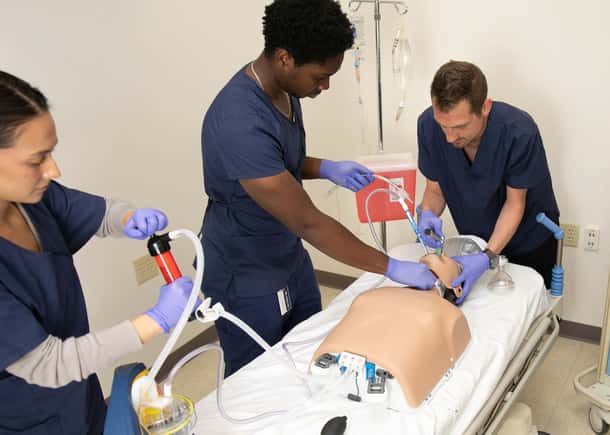
If you're a healthcare educator, your goal is to prepare current or future clinicians for moments when time is short, conditions are uncertain, and every action carries weight.
In the real world, you know that airways are often contaminated with blood, vomit, or other secretions. Yet, traditional airway management education often doesn't include training focused on contaminated airways.1
For many providers, their first encounter with a messy airway happens in a critical patient situation. This can increase stress, errors, and delays. The first time your learners face that reality should never be with a live patient.
Simulation can help you bridge the gap between textbook knowledge and the clinical unpredictability of airway management through realistic, repeatable practice.
Simulation allows your learners to practice, adapt, and build confidence safely through repeated exposure, with immediate feedback on their technique and decision-making.
In this article, we explore the impact of contaminated airway training, strategies for effective airway management, and how you can efficiently create meaningful simulation experiences that prepare your learners for real-world challenges.
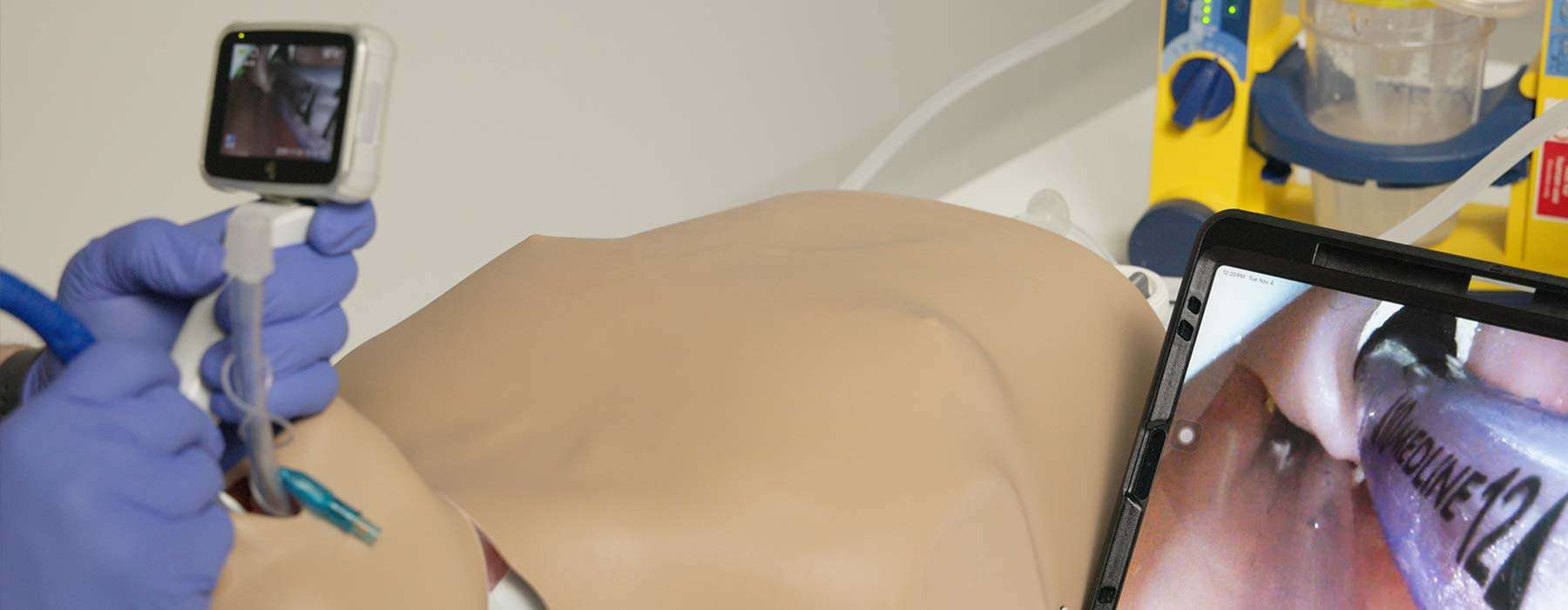
Contaminants have been shown to lower first-pass intubation success.4 Contamination changes everything: fluids obscure landmarks, suction has to be precise, and timing becomes critical. Without practice in these realistic conditions, even the most experienced providers can struggle.
Achieving first-pass success requires more than good laryngoscopy technique. It requires consistent performance under pressure. Your learners also need to manage suction effectively, maintain visualization, coordinate with the team, and make fast decisions.
Suction-Assisted Laryngoscopy and Airway Decontamination (SALAD) is one step-wise method of managing the contaminated airway.5 It’s been shown to improve clinicians’ confidence and ability to effectively handle contaminated airways.6
By practicing techniques like SALAD in realistic, repeatable scenarios, your learners develop the coordination, muscle memory, and composure needed to perform consistently under pressure.
Aspiration is one of the most serious risks during airway management. Dry labs or static manikins make it hard to show how suction timing or positioning affects outcomes.
Realistic, fluid-based simulation practice can provide visual feedback that creates a clear connection between technique and outcome. This can help learners adjust their approach, reinforce consistent technique, and gain confidence.
These experiences accelerate skill development and clinical judgment, turning mistakes into teachable moments without risking patients.
If you're like many others, your time and resources are often limited. Reducing setup and cleanup time, allowing parallel stations, and providing continuous practice opportunities are all ways to increase efficiency and maximize learning impact.
To train effectively for contaminated airway scenarios, you need a solution that can deliver realistic fluid simulation without slowing your program down, while still supporting progression into more complex airway situations.
The Laerdal Advanced Airway Solution is designed to bring contaminated airway training to life in a realistic, efficient, and scalable way. It enables you to run consistent, repeatable contaminated airway scenarios, while also supporting progression into difficult airway and resuscitation training when needed.
Rather than managing multiple manikins for basic airway, difficult airway, CPR, and contaminated scenarios, you can consolidate training into one portable, integrated solution. This reduces equipment redundancy and helps you deliver high-fidelity training more frequently and consistently, even when budgets and time are limited.

Key features that support realistic, repeatable contaminated airway training include:
With the Laerdal Advanced Airway Solution, you can deliver repeated, consistent contaminated airway practice without messy resets or prolonged turnaround time, while still supporting broader airway skill development across increasing levels of complexity.
Beyond individual technique, the Laerdal Advanced Airway Solution also supports team-based training in contaminated airway scenarios. Because airway management often occurs during resuscitation, integrated QCPR feedback helps teams maintain high-quality compressions while managing suction and visualization under pressure.
Teams can rotate roles and practice communication while managing contamination in real time. Dual manikins increase throughput without sacrificing realism, allowing more learners to experience contaminated airway scenarios in less time.
By combining fluid realism with CPR integration, the solution helps move training from isolated skill practice to coordinated team performance in high-pressure, contamination-driven scenarios.
One of the biggest barriers to running contaminated airway training frequently is reset time. The Laerdal Advanced Airway Solution addresses this with an infinite vomit loop that provides continuous contamination, eliminating cleanup between learners during sessions and keeping training moving.
With setup and cleanup in under five minutes and a portable design, you can run efficient contaminated airway training in labs, classrooms, conference rooms, or field settings. Minimal downtime between learners helps you maximize every training window while maintaining realism.
Contaminated airways are common in real clinical situations, but many learners first encounter them during high-stakes patient care. Training prepares them to manage these conditions safely and effectively.
First-pass success is successfully intubating a patient on the first attempt. It is critical because multiple attempts increase the risk of adverse events.
Contamination can obscure anatomical landmarks, make suction critical, and require faster decision-making, all of which can reduce first-pass success.
SALAD (Suction-Assisted Laryngoscopy and Airway Decontamination) is a step-wise method for managing contaminated airways that helps improve confidence and performance.
Simulation allows learners to practice in realistic, repeatable scenarios, helping them build skills, adapt their technique, and gain confidence without risk to patients.
Fluid-based simulation shows how contamination behaves in real time, helping learners understand how technique impacts outcomes.
Repeated exposure helps learners build coordination, muscle memory, and the ability to perform consistently under pressure.
Training can be made more efficient by reducing setup and cleanup time, enabling parallel stations, and allowing continuous practice.
Training that reflects realistic conditions helps learners develop the skills and confidence needed to perform effectively in high-pressure clinical situations.