Meteen naar de inhoud

Tips For Integrating Translational Simulation into Everyday Operations Without Overwhelming Staff or Resources

At a glance 

Translational simulation doesn’t require a simulation center or a large budget to make a difference. It requires intent, structure, and integration. When done right, it becomes part of the way a hospital learns—not an extra task layered on top. 

The legitimate fear of "one more thing"

Healthcare teams are stretched thin. Between staffing shortages, accreditation requirements, daily patient care, and quality metrics, the idea of adding yet another initiative—even one as promising as translational simulation—can feel overwhelming.

That’s understandable. But here’s the good news: translational simulation doesn’t have to be large-scale, expensive, or disruptive. When integrated thoughtfully, it becomes a low-burden, high-impact tool that supports—not competes with—daily operations. 


"This kind of work is a strategy, not an event."1

Dr. Victoria Brazil,

Director, Bond Translational Simulation Collaborative; Professor of Emergency Medicine and Director of Simulation, Bond University

Victoria Brazil

From extra work to embedded practice

Traditional views of simulation are often tied to education centers, manikins, and structured scenarios. But translational simulation operates differently. It’s:


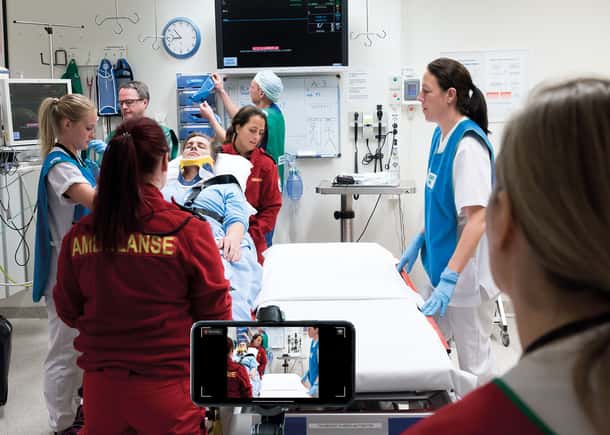
  • Typically in-situ – in the real clinical environment
  • System-focused – targeting process and other operational gaps, not just clinical knowledge
  • Brief and iterative – often taking just 20–30 minutes
  • Problem-oriented – tied to real risks, projects, or change efforts


Rather than scheduling a quarterly simulation day, translational simulation becomes a mode of inquiry and improvement—built into how the organization operates. 

Organizations that are fully immersed in using simulation for quality improvement devote considerable resources to their efforts with resulting high returns on their energy and investment. If you are just getting started, here is a way you can still have major impact.

7 practical strategies for low-burden integration 


1. Start with a single use case 

Pick a known challenge—something you’re already trying to improve. Maybe it’s delayed response to pediatric sepsis, miscommunication during trauma alerts, or uncertainty in a new escalation protocol. Design one 15–30-minute simulation around that.


Example: Before opening a newly designed trauma center, clinicians at a hospital in Toronto, Canada conducted simulation exercises that revealed workflow issues, equipment placement problems, and communication challenges. Changes were made before the first patient entered the unit, reducing latent safety threats and improving readiness.2


2. Use simulation to “pressure test” change 

Before launching a new protocol, medication, or process, test it in action through simulation. 


"It’s a way to crash test the system just like you would crash test a car to make sure it’s as safe and effective as possible. This allowed us to iron out the kinks so that by the time real trauma patients were involved, the only impact they were more likely to see was better outcomes."3

Dr. Andrew Petrosoniak MSc (Med Ed), FRCPC,

Emergency Physician and Trauma Team Leader at St. Michael’s Hospital in Toronto, Canada

Andrew Petrosoniak


Integrating simulation into your existing QI or implementation plan makes it proactive, not additive.


3. Make it part of the safety toolkit 

Treat simulation like a stethoscope for your system. Use it during:


  • Safety huddles
  • Mock codes
  • Debriefs after events
  • New employee onboarding
  • Environmental readiness checks 


These are natural points where a 10–15-minute simulation fits—and where it can reveal system-level issues. 


4. Prioritize “just enough fidelity”

You don't always need the most sophisticated technology or full simulation centers. For translational simulation, the focus is workflow, communication, space, and process. Use what gives you the most immersive experience for the circumstances at hand.


  • Real rooms
  • Real teams
  • Real protocol
  • Something that equates to a patient necessary for the exercise


Always consider the level of feedback you want from the patient perspective. If you want no feedback, a skills trainer or even a mock patient may be appropriate. If you need verbal response, a standardized patient may work. If you need to know impact on patient condition and correlating data, an appropriate mannequin will be your best choice.


"We used simulation-informed clinical design to put both our old and new trauma bays through their paces. To do so, we brought a number of simulation modalities to bear, selected based on the task at hand."4

Dr. Andrew Petrosoniak


5. Share the work across roles 

Don’t wait for a single simulation champion to do it all. Instead, train a core team of facilitators—including nurses, physicians, quality leaders, and educators—to run and debrief simulations. This shared model builds internal capability—and resilience.


Tip: Use brief “STOP/THINK/ACT” debriefs rather than long-form reviews. Even 5 minutes of structured discussion can yield insights.


6. Align with ongoing quality projects 

Tie simulation directly to ongoing safety efforts, such as: 


  • Sepsis bundle compliance 
  • Obstetric hemorrhage protocols 
  • Stroke team activation 
  • Medication error reduction 


By using simulation as part of a Plan-Do-Study-Act (PDSA) cycle, you avoid creating a new initiative—instead, you strengthen an existing one.


"Simulation can become a testbed. It can become a place where the people who are actually doing the work get to explore it and get to offer ideas about how to make it better."5

Dr. Victoria Brazil


7. Start small. Publish later.

Not every simulation needs to be a research study. Start with “micro-simulations” and track simple ...outcomes. Just some examples are: 


  • Time to medication
  • Task completion
  • Communication clarity 
  • Staff confidence


Share results in safety huddles, department meetings, or dashboards. Once embedded, you can expand to larger studies and publications. 
Real-world examples of low-burden integration

St. Michael’s Hospital, Toronto

Their trauma team used quick, iterative simulations to test and redesign their trauma bay before construction. Each simulation session lasted under 45 minutes but uncovered dozens of safety threats.6

Obstetric Hemorrhage Simulations in Rural Nebraska

Bryan Health facilitated 20-minute in-situ hemorrhage simulations across 12 rural hospitals. These short, staff-led exercises led to improved emergency cart placement and transfusion protocols—without requiring large-scale simulation days.7

Getting started without burnout 

If you're ready to begin—or improve—translational simulation without taxing your team, here’s a simple plan: 


Step
Description
1. Pick one process Choose a real-world workflow to test (e.g., code blue, OB hemorrhage, sepsis response). 
2. Design a 20-minute scenario Use real rooms, real gear, and current staff. Focus on flow, timing, and team communication. 
3. Observe & debrief Watch for latent safety threats. Use a short team debrief: “What helped? What hindered?” 
4. Implement a fix Adjust layout, communication, or supplies. 
5. Re-test & reinforce Run again to evaluate the fix. Share results. Build momentum. 

Key takeaway


Translational simulation doesn’t need to be big to be effective. Start small, focus on real problems, use what you have, and embed learning into daily operations.


Translational simulation doesn’t need to overwhelm—it needs to integrate. It’s not extra work. It’s better work, done smarter, sooner, and together. 

You may also like...

Contact us about Health Quality Improvement Solutions

We verwerken uw persoonlijke gegevens met zorg en zoals beschreven in Laerdal's Privacy Policy.

We verwerken uw persoonlijke gegevens met zorg en zoals beschreven in Laerdal's Privacy Policy.

References

  1. Laerdal Medical. “Improving Outcomes in the NICU: A Systems Approach to Safer Care.” Webinar, 2026. https://www.youtube.com/watch?v=Oi5CDiQAYXg
  2. Moussa, Ahmed, et al. “Interprofessional Collaboration in Building In Situ Simulations to Identify Threats to Patient Safety Before Transitioning to a New Healthcare Environment: Neonatal Intensive Care as an Example.” Cureus, March 25, 2025. https://pmc.ncbi.nlm.nih.gov/articles/PMC12021303/
  3. Laerdal Medical. “How Can You Use Simulation to Identify and Fix System-Level Problems?”
    https://laerdal.com/us/solutions/healthcare-quality-improvement/resources/how-can-you-use-simulation-to-identify-and-fix-system-level-problems/
  4. Laerdal Medical. “What Is Translational Simulation?”
    https://laerdal.com/us/solutions/healthcare-quality-improvement/resources/what-is-translational-simulation/
  5. Laerdal Medical. “How Translational Simulation Can Drive Healthcare Quality Improvement.”
    https://laerdal.com/us/solutions/healthcare-quality-improvement/resources/how-translational-simulation-can-drive-healthcare-quality-improvement/
  6. Bentley, Suzanne K., et al. “Hospital-Wide Cardiac Arrest In Situ Simulation to Identify and Mitigate Latent Safety Threats.” Advances in Simulation, May 21, 2022.
    https://doi.org/10.1186/s41077-022-00209-0
  7. Bryan Health. “Case Study: High-Tech OB Simulation Training Educates OB Teams, Improves Quality of Rural Health Care.”
    https://www.bryanhealth.com/app/files/public/0e55e9f8-2e84-4155-bcf9-8a4c65fcfd11/rural-ob-simulation-case-study.pdf