Webinar: The Future of Maternal Safety - From Training to Systems Improvement
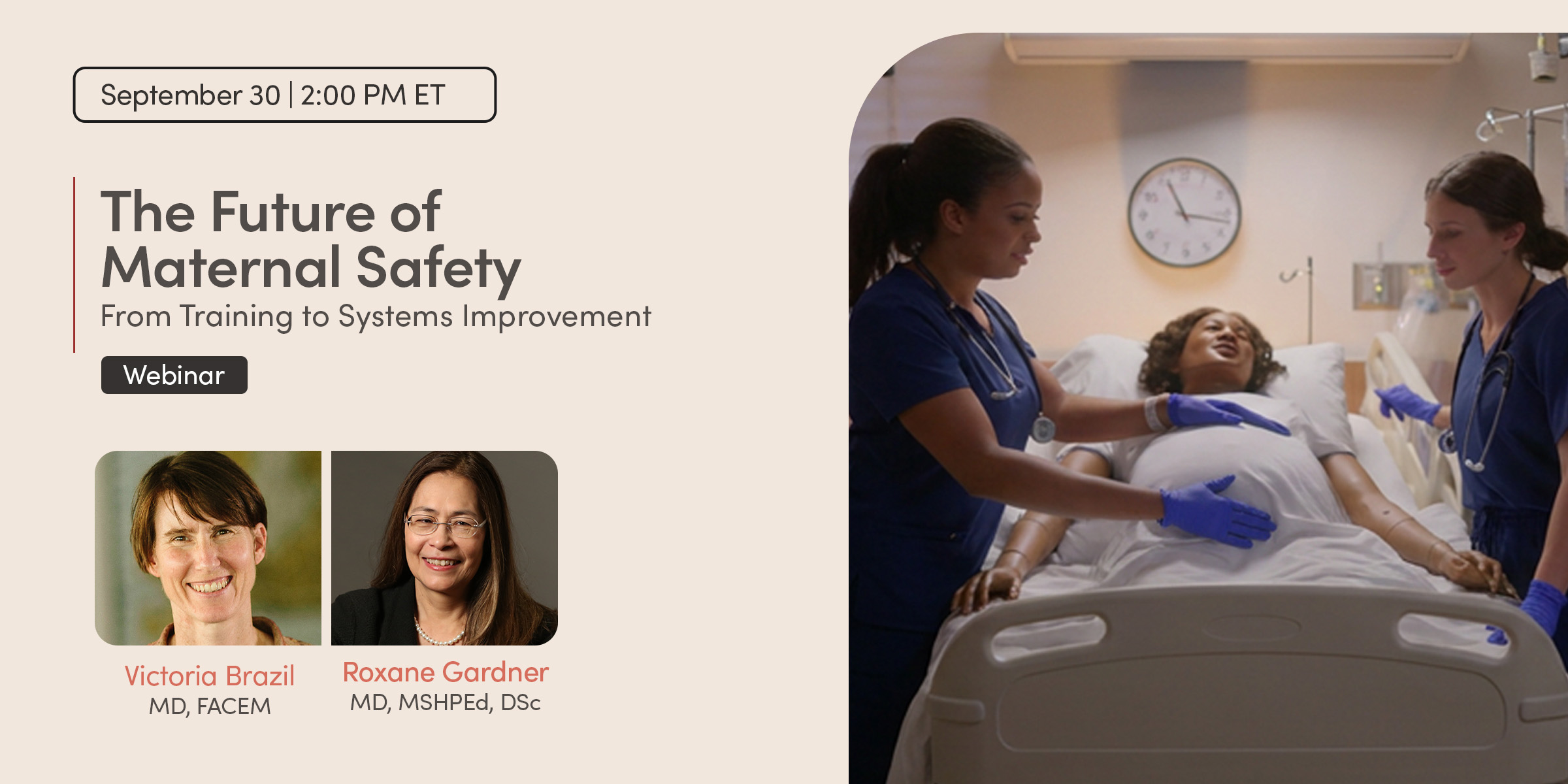
The Future of Maternal Safety: From Training to Systems Improvement
Join us for a focused conversation on how simulation can help improve maternal safety—by strengthening not only the people delivering care, but the systems that support them.
Most labor and delivery teams already train for maternal emergencies. They practice responding to hemorrhage, hypertension, and other high-risk events.
But safer maternal care depends on more than individual knowledge and skills. It also depends on how teams, workflows, equipment, environments, communication, and decisions come together—often under tremendous pressure.
The question is no longer solely: “Are our people prepared?”
It's: “Does our system consistently enable them to deliver the safest possible care?”
This session brings together two internationally recognized leaders in simulation, obstetrics, and systems improvement to explore how organizations can move beyond periodic maternal safety drills and use simulation to uncover risk, test improvements, and strengthen the systems in which care is delivered.
What you'll gain
- ✓A clearer understanding of how system gaps—not just individual performance—can affect maternal outcomes
- ✓How simulation can reveal vulnerabilities before they contribute to patient harm
- ✓Ways to turn maternal safety drills into opportunities for continuous systems improvement
- ✓Why immersion matters when testing how care actually works
- ✓Practical ideas for beginning this journey in your own organization
Why this matters
Even highly trained teams can be limited by the systems around them.
Simulation offers an opportunity to see those systems differently—to test workflows, uncover hidden risks, explore solutions, and learn before the next real emergency.
The goal isn't to stop training people.
It's to create systems that allow well-trained people to perform at their best.
Who should attend
- ✓Obstetric & Labor and Delivery Leadership
- ✓Hospital Leadership
- ✓Risk & Quality Managers
- ✓Patient Safety Leaders
- ✓Simulation Center Leadership
Reserve your spot
You don't need to rebuild your simulation program to begin improving the system.
You may simply need to start asking different questions of the simulation you're already doing.

Roxane Gardner, MD, MSHPEd, DSc
Pediatric & Adolescent Gynecologist, Division of Gynecology
Assistant Professor of Obstetrics, Gynecology and Reproductive Biology, Harvard Medical School
Senior Director, Clinical Programs; Director, Fellowships & International Scholars Program, Center for Medical Simulation
Dr. Gardner's pioneering work in simulation, teamwork, communication, and patient safety has helped demonstrate how simulation can influence not only clinical performance, but real-world outcomes and organizational risk.

Victoria Brazil, MD, FACEM
Emergency Physician and Simulation Leader
Gold Coast Health & Bond University, Australia
Dr. Brazil is internationally recognized for advancing translational simulation—the use of simulation to improve healthcare systems by identifying risk, testing processes, and translating what teams learn into meaningful improvements in care.