Ensuring EMS Readiness for Maternal Care Through Simulation

Maternal care deserts are counties where no obstetric services are available, whether from hospitals, birth centers, or obstetric providers like certified nurse midwives.
The growth of these maternal care deserts is resulting in Emergency Medical Services (EMS) providers assuming the critical role of managing out-of-hospital births. This includes responding to unplanned roadside deliveries as well as supporting an increase of more community births at home. Due to this shift, competency in managing obstetric scenarios is more crucial than ever.
We sat down with two experts in EMS and simulation for a webinar to discuss this topic: Beyond the Hospital Walls: Advancing EMS Practice in Maternal Care.

Melissa Lawlor, CNM, FNP, EMT
Midwives Untethered
Melissa Lawlor, an innovative and passionate leader in the fire/EMS community, serving as the Deputy Coordinator for First Responder Health and Wellness in Dutchess County. With a remarkable 30-year tenure as a volunteer in the Fire/EMS realm, Melissa also serves as a Pleasant Valley Fire Commissioner specialized EMS Liaison. She seamlessly integrates her expertise in Fire/EMS, Midwifery, and Family Practice Medicine. Melissa is a trailblazer in EMS continuing education, developing cutting-edge CME sessions that incorporate evidence-based practices. Her work spans OB/GYN, Newborn, Pediatrics, and Firefighter/EMS Health and Wellness, addressing unique health challenges faced by women in fire.

Elizabeth Travis, DHSc, NRP
Laerdal Medical
Dr. Elizabeth H. Travis, DHSc, NRP, MBA, is a paramedic, educator, and healthcare leader advancing maternal care in prehospital settings. Her doctoral research focused on improving outcomes in maternal care deserts through midwife-style paramedic training. A former Lieutenant Paramedic and EMS educator, she has trained clinicians in high-performance CPR, maternal/postnatal care, and stress management. Her work has been featured in The JEMS Report and presented at EMS conferences. Dr. Travis serves on EMS nonprofit boards and continues to practice and speak nationally on maternal health and emergency care, driving scalable, data-informed solutions to strengthen community and maternal health.
In this article, we provide highlights and key takeaways from the webinar. Read on to hear the experts’ insights on how simulation can effectively prepare medics to make an impact on maternal outcomes and build confidence and competency to welcome new lives in their communities.
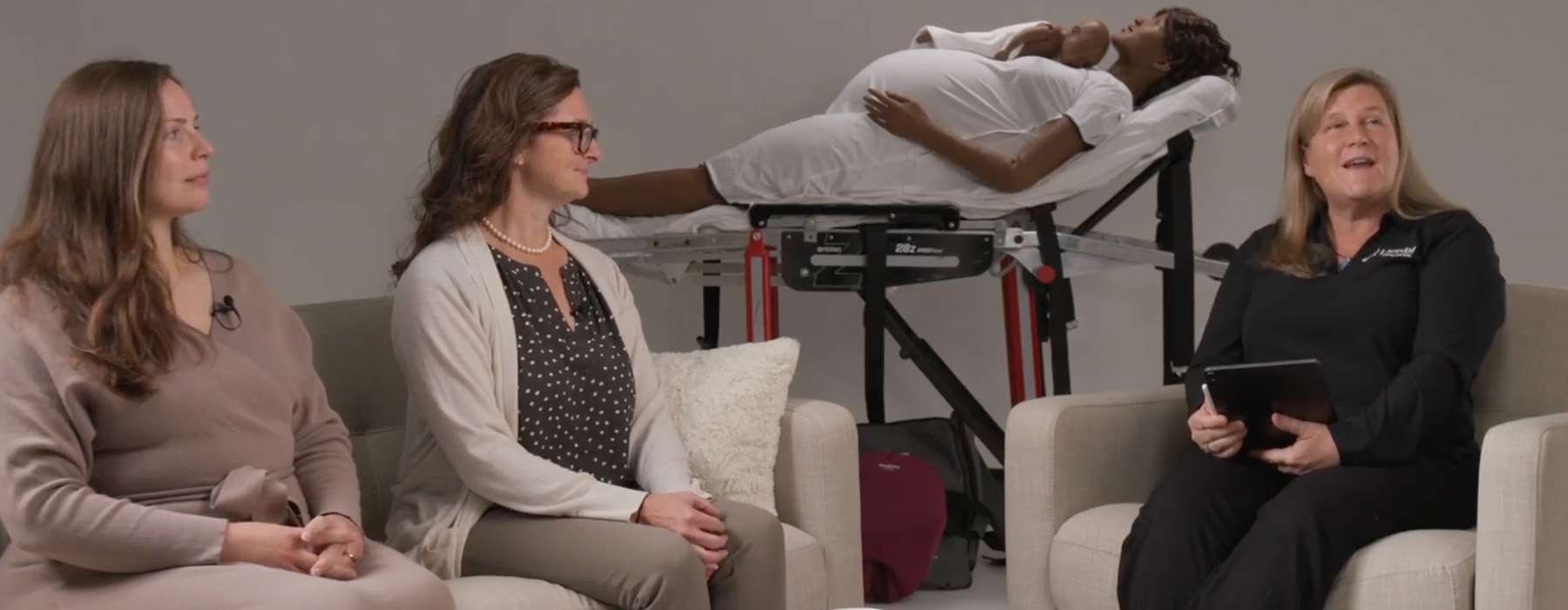
“There’s a shift within healthcare right now, where we’re losing labor and delivery departments,” explained Elizabeth Travis, DHSc, NRP. “Mothers may not be as comfortable relying on the healthcare system for their children’s care as they once were, or they encounter challenges that make access difficult.”
“There’s just a large gap in availability of care,” she continues. “And who is called to meet that gap if you don’t have a midwife there? They call us. The medics, the EMTs.” She adds, “You’re about to get a lot more calls – because we’re looking at bigger and bigger gaps in actual availability of care.”
“You’re that middle ground,” she said. “Whether you’re a volunteer or a career medic, you’re now the care.”
Historically, there has been limited, non-contextualized training to help EMS providers prepare for maternal cases. “It’s a high acuity, low [frequency] event – but that means it’s even more important to train it,” Dr. Travis points out.
The lack of effective training has left many providers fearful. “I know from my own research that that’s part of the missing link,” Dr. Travis shared. “All these medics were telling me, ‘We’d love to do it, but we’re terrified going in because we haven’t been trained to do it.’”
Current training falls short of the reality EMS providers are managing in the field. For example, many medics only observe C-sections in a hospital during their initial certification training. But this controlled environment doesn’t prepare them for the uncontrolled environment of managing a physiological or emergent birth in the field.
– Elizabeth Travis, DHSc, NRP
Laerdal Medical

Both experts agreed that contextualized simulation training is crucial for building provider competence.
– Melissa Lawlor, CNM, FNP, EMT
Midwives Untethered
Simulation can help build competence by allowing medics to train in areas like:
The experts agreed that in maternal cases, communication should focus on the mother, rather than the usual focus on team communication. Compared to trauma or cardiac arrest, where the patient is not necessarily communicating with the provider, a maternal case is different.
“It needs to be a refocus on mom and baby,” Dr. Travis advised. “I think we do team communication pretty well. That’s not new in EMS. “[But the mother] is there with you through a very big life event and a very big medical event.”
Key communication skills to include in your simulations:
1. Patient guidance: Since the mother can’t actually see what’s happening, providers should verbally guide her on what’s happening (i.e., seeing the baby’s head).
2. Using soft, present language: “It’s being soft. It’s being present. It’s taking that moment to pause,” Melissa said. “It’s a different language that you’re going to use. We want her to feel seen, heard, and safe. That’s so important.”
3. Asking for consent: Providers should get consent before administering medications or performing procedures. Melissa advised practicing language like, “Is it okay with you if we go ahead and do XYZ?” She added, “Explain everything before you do it. That’s super important.”

Some of the key strategies the experts discussed include:
Contextualize your training. Training must move away from the hospital setting and recreate the realities of the field. “Stop training like you were taught, which is the hospital setting. Start training in the bathroom, out in the cars, things like that. Small shifts,” Dr. Travis advised.
Laerdal tip: You may want to consider recording your simulations using a portable recording system designed for in situ training, like the SimCapture Mobile App. Reviewing the recording during debriefing will give medics a “view of themselves from the outside,” providing rich opportunities for self-reflection.
Strive for real-life chaos. “We’re giving them the tub births [in our training],” Melissa said. “We’re giving them the closet births. The full monty of a hemorrhage or a shoulder dystocia with a baby who’s not breathing right – and they’re working through all of this with the commotion in the background. [This] is how we should be training.”
Laerdal tip: Maximize realism with a maternal and birthing simulator like MamaAnne. From realistic contractions to postpartum hemorrhage management, this high-fidelity simulator can immerse medics in true-to-life scenarios. If you’re on a budget, a trainer like MamaBirthie allows for training on essential birth maneuvers and respectful communication.
Train frequently. “It’s drills. It’s practice,” advised Melissa. “It’s like CPR. When you drill it down and you’re practicing it, it becomes rote memory in a way.”
Laerdal tip: Competence is achieved through frequent practice and assessment of learning. A simulation management system like SimCapture for EMS Training can help you collect, monitor, and analyze simulation data on medics’ progress. Use it to get actionable insights to guide remediation and corrective training efforts.

Dr. Travis and Melissa provided some meaningful suggestions that agencies can implement. Including these in your simulation scenarios will ensure that providers receive the low-dose, high-frequency training they need to feel confident.
EMS providers are becoming increasingly responsible for out-of-hospital maternal care due to growing gaps in obstetric access – making obstetric competency more critical than ever.
Realistic, contextualized simulation training—rather than hospital-based observation—builds the competence and confidence medics need to manage high-acuity, low-frequency birth scenarios.
Effective maternal simulations must emphasize both technical skills and mother-centered communication, preparing EMS providers to deliver safe, supportive care in unpredictable environments.